
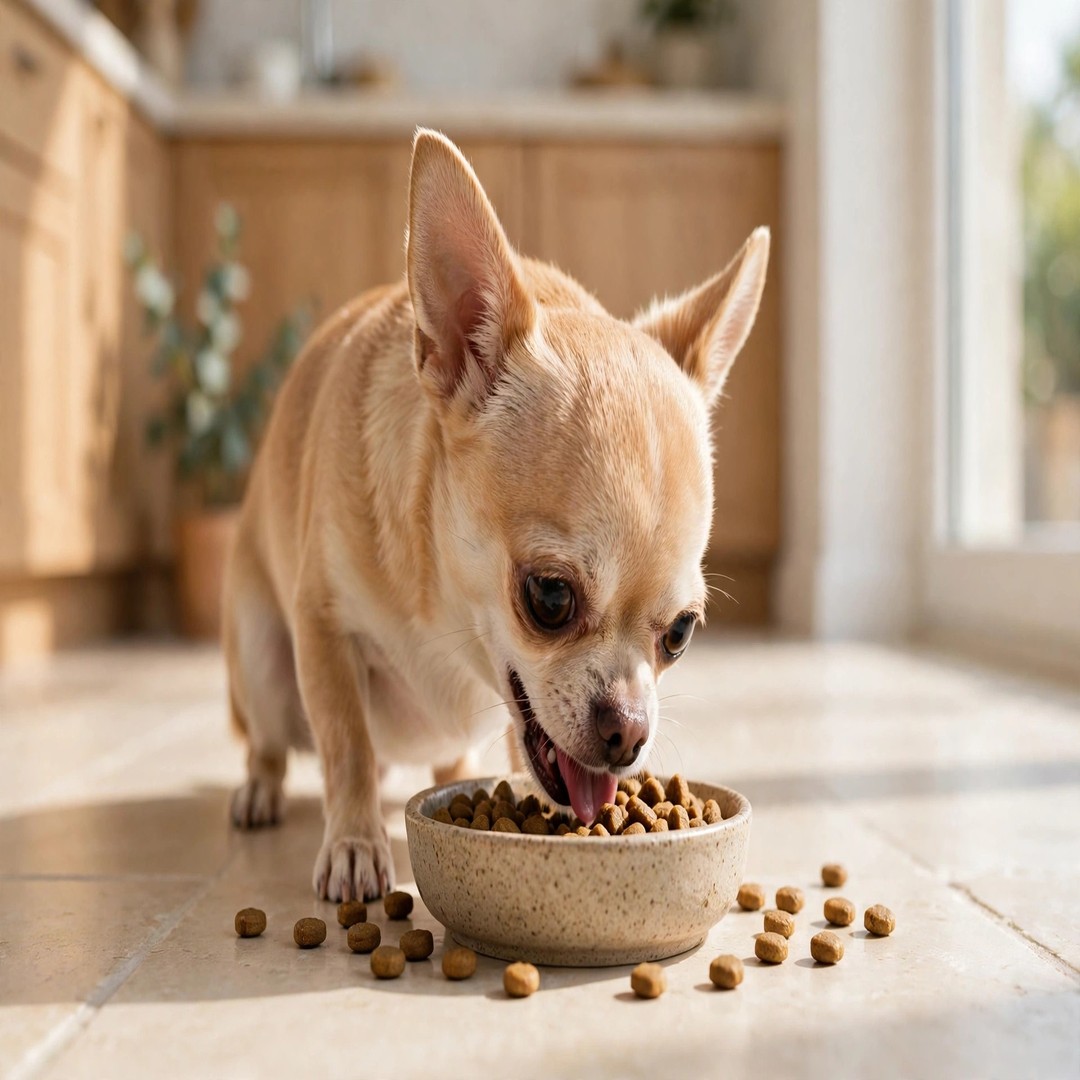
Your dog weighs eight kilos, eats like a bird, and somehow still manages to beg for your dinner. You are standing in the pet shop aisle staring at twenty bags of dog food, and every one of them claims to be the best. The small-breed bags are the smallest and the priciest, and you are wondering whether your little dog actually needs special food — or whether it is just clever packaging.
The honest answer is that small dogs do have different needs from big dogs, and the food matters — but not for the reasons the packaging shouts about. Here is how to choose well, without getting fooled by the label.
Why This Matters
A small dog is not just a scaled-down big dog. A Chihuahua burns energy faster, per kilo, than a Labrador. Her stomach is tiny, so she can only eat small amounts at a time. Her teeth are crowded into a small jaw, which makes dental problems more common. And she can live for fifteen years or more, so the food you choose now is a decision that plays out over a very long life.
The wrong food does not usually cause a dramatic problem. It causes slow ones: a dog that is always a little overweight, teeth that decay early, or a fussy eater that turns her nose up at every meal. Getting the food right early saves you vet bills, and it saves your dog years of quiet discomfort.
What Makes a Small Breed Different?
A faster metabolism
Small dogs burn calories faster than large dogs, relative to their size. A ten-kilo dog needs more calories per kilo than a thirty-kilo dog. That is why small-breed foods are usually more calorie-dense — your dog gets the energy she needs from a smaller portion, which matters when her stomach is the size of a satsuma.
A tiny stomach
A small dog cannot eat a big meal in one sitting. She needs two or three small meals a day, and the food needs to be easy to eat in small amounts. A food that is too bulky or too hard to chew will leave her half-fed, even if the bowl looks full.
Crowded teeth
Small jaws mean crowded teeth, and crowded teeth trap food and plaque. Small dogs are far more prone to dental disease than large dogs, and dental disease is not just about bad breath — it can lead to pain, tooth loss, and even heart and kidney problems. Kibble size and texture matter here more than most owners realise.
A long life
Small breeds often live several years longer than large breeds. A good diet is a long game: what she eats at three affects how she feels at thirteen. That is a reason to choose well, not a reason to panic — a steady, balanced diet beats a perfect one that you keep changing.
What to Look For on the Bag
A small kibble size
This is the single most important practical difference. Small-breed kibble is made in smaller pieces that a little mouth can actually pick up and chew. A large kibble is not just awkward — many small dogs simply swallow it whole, which defeats the point of chewing and does nothing for their teeth. If your dog is leaving kibble in the bowl or crunching once and swallowing, the pieces may be too big.
Named meat first
Look for a food where the first ingredient is a named meat — chicken, lamb, beef, salmon — not a vague word like “meat” or “animal derivatives”. The first ingredient is the biggest one by weight, so it tells you what the food is mostly made of. A food that starts with a grain or a by-product is mostly filler.
A complete and balanced statement
On the bag, look for words like “complete and balanced” and a reference to a recognised standard, such as FEDIAF in Europe or AAFCO in the US. That statement means the food has been formulated to contain everything a dog needs, in the right proportions. A food without it may be a treat or a topper, not a full diet.
A life-stage match
Puppies, adults, and seniors need different things. A small-breed puppy needs more calories and more calcium for growth; a senior needs fewer calories and more joint support. Buy the food that matches your dog’s age, not just her size, and switch when she moves into a new life stage.
No need for exotic extras
Ignore the marketing words — “grain-free”, “superfood”, “ancestral”, “holistic” — and read the ingredients instead. Grain-free is not automatically better, and some grain-free diets have been linked to heart problems in dogs. A food with good-quality grains like rice or oats is perfectly fine for most dogs, unless your vet has told you otherwise.
How Much to Feed
Follow the feeding guide on the bag as a starting point, then adjust by looking at your dog. You should be able to feel her ribs easily under a thin layer of fat, and she should have a visible waist when you look down at her from above. If you cannot feel her ribs, she is getting too much. If they stick out, she is getting too little.
Small dogs gain weight fast, because a few extra treats are a big percentage of their daily calories. A single biscuit can be the equivalent of a whole meal for a tiny dog. Measure her food with a cup or scales, and count treats as part of the daily total — not on top of it.
Wet Food, Dry Food, or Both?
Dry kibble is the practical choice for most small dogs: it is easy to store, easy to measure, and the crunching helps clean the teeth a little. Wet food is softer and smellier, which makes it tempting for fussy eaters, but it does nothing for dental health and it spoils fast once opened.
Many owners mix the two — a base of kibble with a spoonful of wet food on top — and that works well. What matters is that the total amount is right, and that the food is complete and balanced, whichever form it comes in. Never feed a diet of table scraps or home-cooked meals without a vet or a qualified nutritionist checking it, because a home-made diet is very easy to get wrong.
Switching Foods Without an Upset Stomach
If you are changing your dog’s food, do it slowly over a week. Mix a quarter of the new food with three quarters of the old for two days, then half and half for two days, then three quarters new, then all new. A sudden switch is the most common cause of a few days of soft stools — and it is easily avoided.
Watch for signs the new food does not suit her: soft stools that last more than a few days, vomiting, itchy skin, or a dull coat. Those are reasons to try a different food, or to ask your vet. A food that suits one small dog may not suit another, and that is normal.
When to Ask Your Vet
Most small dogs do fine on a good-quality commercial food. But ask your vet if your dog has a sensitive stomach, a food allergy, kidney or liver problems, or if she is losing or gaining weight despite a measured diet. Some conditions need a prescription diet, and no bag on a supermarket shelf can replace that advice.
Also ask if your dog is a very fussy eater. A dog that refuses food for more than a day is not being stubborn — something is wrong, and it could be her teeth, her stomach, or stress. Do not wait it out.
The Bottom Line
The best dog food for small breeds is a complete and balanced food with a named meat first, in a kibble size your dog can actually chew, matched to her life stage, fed in measured amounts. You do not need the most expensive bag in the shop — you need the one that fits her mouth, her stomach, and her life.
What food does your little dog eat — and what finally made her finish the bowl? Tell us in the comments; small-dog owners will love the honest answers.
This article is for general information only and is not veterinary advice. If you are worried about your dog’s diet or health, please consult a veterinarian.