
An indoor cat lives in a small world — your home. That world can be a paradise of sunny windowsills, high shelves, and hidden toys, or it can be a boring box with the same four walls every day. A bored cat does not just look sad. Boredom shows up as overeating, over-grooming, scratching the furniture, waking you at 3 a.m., and sometimes as real stress. The good news is that keeping a cat entertained indoors does not take much money or much time. It takes a little thought about what cats actually enjoy.
Cats are hunters at heart, even the ones who have never set foot outside. Everything that entertains a cat taps into that same hunting instinct: stalking, chasing, pouncing, climbing, and exploring. Give them safe ways to do those things indoors, and you will have a calmer, happier cat.
Why this matters
Indoor cats live longer, safer lives on average — no traffic, no fights with other animals, fewer parasites and diseases. But safety without stimulation is a trade-off. A cat with nothing to do gets restless, and restlessness turns into the behaviors owners complain about most: midnight zoomies, shredded sofas, and constant meowing for attention.
Play and enrichment are not luxuries. They are how an indoor cat stays fit, keeps a healthy weight, and avoids the stress that comes from a life with nothing to hunt. Even ten minutes of real play a day changes a cat’s mood — and yours.
Play the way cats actually play
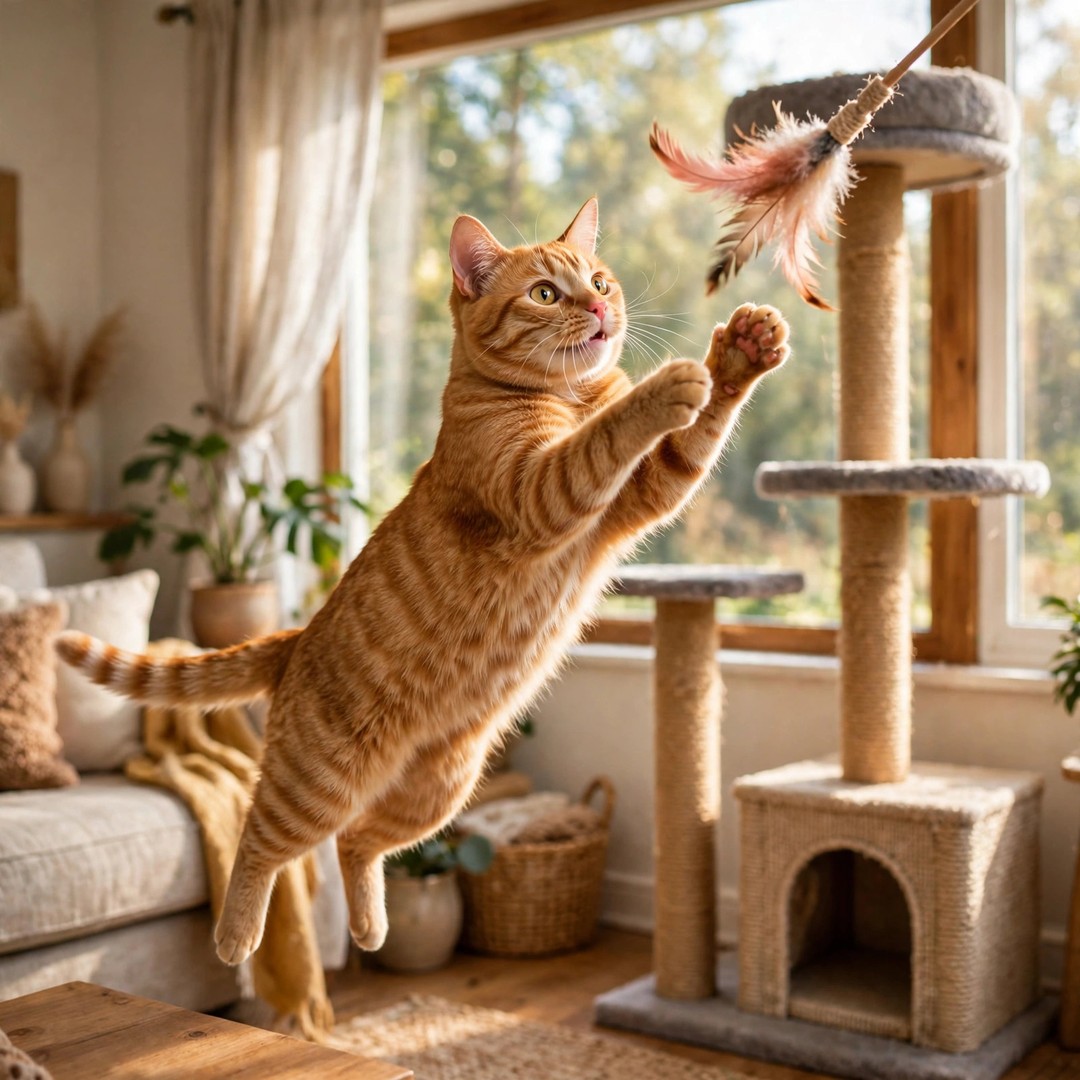
The best cat toy is not the expensive one from the pet store. It is the one that moves like prey. A wand toy with a feather or a strip of fabric on the end, dragged along the floor, flicked around a corner, or dangled just out of reach, triggers the full hunting sequence: stalk, chase, pounce, catch.
A few rules make play sessions work:
- Keep it short and often. Two or three sessions of five to ten minutes beat one long session. Cats hunt in bursts.
- Let them win. Always let your cat catch the toy at the end, then offer a small treat. A hunt that never ends in a catch is frustrating, not fun.
- Move the toy like prey. Drag it away from your cat, not toward them. Hide it behind furniture. Make it pause, twitch, and dart. A toy that just dangles in one place is boring.
- Rotate toys. Put half the toys away and swap them every week. A toy that reappears after a week away is suddenly interesting again.
Never play with your hands or feet as the toy. A kitten who learns hands are for biting becomes an adult cat who bites hands — and that is a hard habit to undo.
Climbing and high places
Cats think in three dimensions. A room with no high places feels small and exposed to a cat. A room with shelves, a tall cat tree, or even a cleared top of a wardrobe feels like a whole territory to patrol.
A sturdy cat tree near a window is the single best piece of furniture you can buy for an indoor cat: a place to climb, a place to scratch, and a high perch to watch the world from. If a full cat tree is too much, wall-mounted shelves at different heights work just as well, and they take up no floor space. Make sure anything your cat climbs is stable — a shelf that wobbles or a tree that tips will put your cat off climbing for good.
Give your cat a perch at every window they like. A sunny windowsill with a view of birds, leaves, and people passing is television for cats. Some owners set up a bird feeder outside a favorite window — just far enough away that the birds are safe — and their cat will watch it for hours.
Food puzzles: make dinner a hunt
In the wild, a cat works for every meal. In your kitchen, the food appears in a bowl, and the hunt is over in two minutes. Food puzzles bring the work back. A puzzle feeder, a slow-feeder bowl, or even a few kibbles scattered across the floor or hidden inside a cardboard box turns mealtime into a game that takes ten or fifteen minutes and uses your cat’s brain.
Start simple: scatter a few treats in a muffin tin, or put kibble inside an egg carton with the lid open. As your cat gets the idea, you can try puzzle toys with sliding panels or balls that drop kibble when rolled. For wet food, a lick mat smeared with a thin layer of food keeps a cat busy and calm.
Hide, explore, and change the scenery
Cats love novelty. A cardboard box with a hole cut in the side is a fort, a hiding place, and a toy all at once — and it costs nothing. A paper bag on its side, a tunnel made from an old blanket draped over chairs, or a few boxes arranged as a maze will keep a cat exploring for days.
Change the scenery regularly. Move a box to a new corner, hang a new toy from a door handle, put a fresh towel on a favorite chair. You do not need to buy anything new: rearranging what you already have is enough to make the same room feel new to a cat.
If you have safe indoor plants, cat grass or catnip plants give your cat something to nibble and sniff. Just make sure every plant in your home is safe for cats — lilies, for example, are extremely toxic to cats, even a small amount, and should never be in a home with a cat.
The 3 a.m. problem
The most common complaint from indoor cat owners is the cat who wakes them in the middle of the night. This is almost always a boredom problem, not a spite problem. Cats are most active at dawn and dusk, and a cat who slept all day with nothing to do will be wide awake at 3 a.m.
The fix is a good play session in the evening — ten minutes of active wand-toy play, followed by a small meal or treat — which mimics the natural hunt-eat-sleep cycle and helps your cat settle for the night. Then ignore the 3 a.m. meowing as much as you can. Every time you get up and feed or play with a cat at night, you teach them that meowing at night works.
Two cats, or one?
If you are away for long hours, a second cat can be wonderful company — but only if the cats get along. Two cats who like each other will play, groom, and sleep together. Two cats who do not will add stress, not remove it. If you are considering a second cat, introduce them slowly, with separate rooms at first, and give each cat their own food bowl, water bowl, litter box, and resting spots. The rule for litter boxes is one per cat, plus one extra.
Signs your cat is bored
Watch for these: sleeping far more than usual, overeating, grooming one spot until the fur thins, scratching furniture more than usual, and constant attention-seeking. If you see several of these, your cat is telling you they need more to do. Add one new activity at a time and watch what changes. Most cats respond within a week.
An indoor cat does not need the outdoors to be happy. They need a home that gives them things to climb, things to chase, things to watch, and a puzzle to solve at dinner. Give them that, and the cat who shredded your sofa becomes the cat who naps in the sun, content and calm.
What keeps your indoor cat happiest — the window, the wand toy, or a cardboard box? Tell us in the comments.
This article is for general information only and is not veterinary advice. If your cat shows sudden changes in behavior, appetite, or grooming, please consult a veterinarian.