
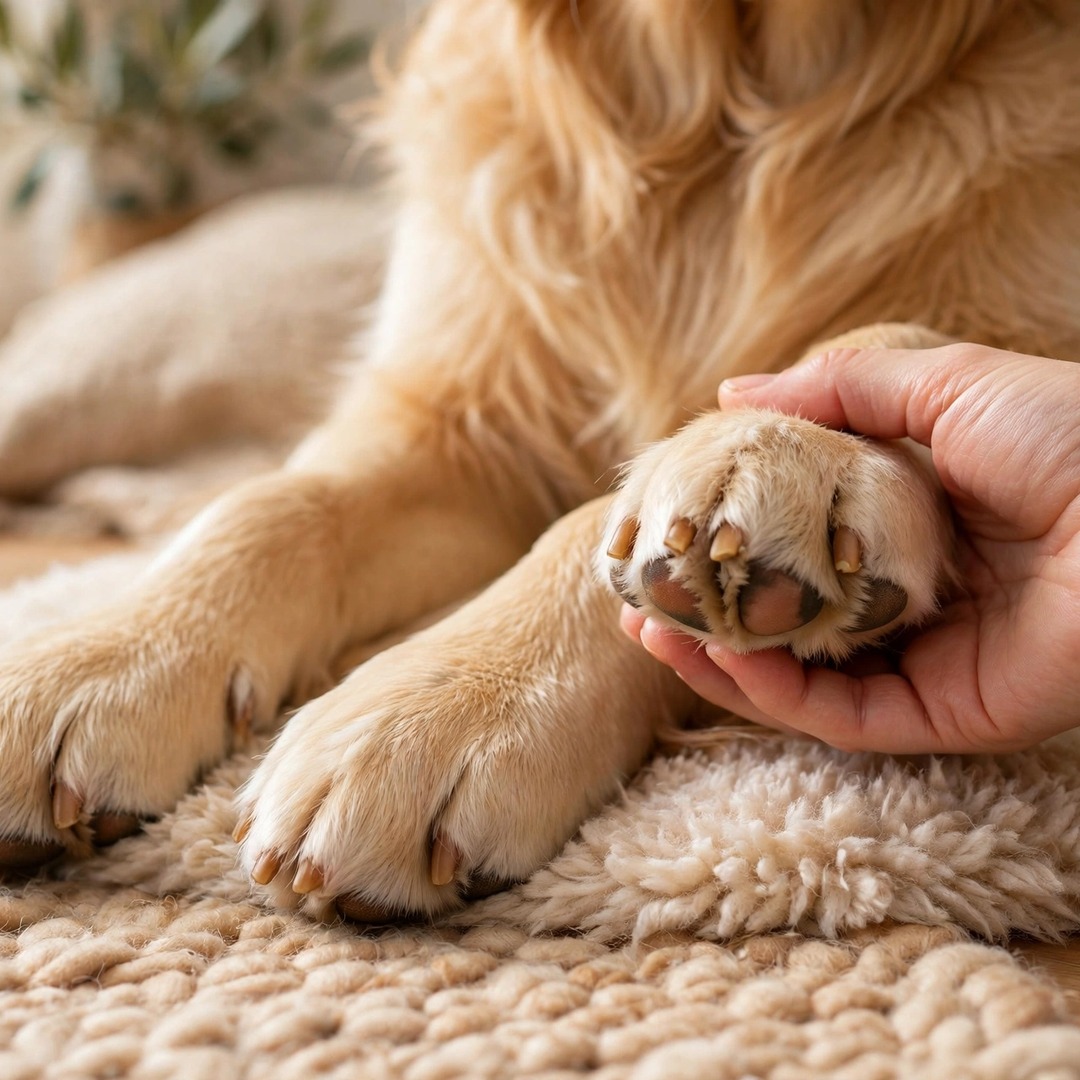
You are drying your dog after a walk, and you notice it: a small crack on one of his pads, a nail that has grown long and curved, and a patch of fur between his toes that is matted and red. He pulls his paw away when you touch it, and he has been licking it all evening. Your dog’s paws carry him everywhere — across pavements, through fields, up stairs, and into mud — and they take more wear than any other part of his body. Here is how to keep them healthy.
A dog’s paws are tougher than they look, but they are not indestructible. Pads can crack, burn, and cut. Nails can grow too long and change the way a dog walks. And the skin between the toes is one of the easiest places for infections to start. The good news is that most paw problems are easy to prevent, and a simple weekly check catches the rest early.
Why This Matters
Your dog’s paws are his shoes, his hands, and his shock absorbers all in one. Every step he takes lands on them, and every walk, run, and jump depends on them being in good shape. A dog with sore paws walks less, plays less, and can become stiff and unhappy — not because he is lazy, but because every step hurts.
Paw care also matters because dogs are very good at hiding pain. A dog will keep walking on a cracked pad or a sore toe long after it has started to hurt, and by the time he is limping, the problem has often been there for a while. A quick weekly check is the simplest way to catch trouble while it is still small.
What Healthy Paws Look Like
A healthy dog’s paws are easy to recognise once you know what to look for. The pads should be smooth, dark, and slightly rough to the touch — not dry, cracked, or peeling. The nails should be short enough that they do not click loudly on a hard floor, and they should not curl sideways or touch the ground when your dog is standing still. The fur between the toes should be clean and dry, with no redness, smell, or matted clumps. And your dog should let you touch and hold each paw without flinching or pulling away.
What is not normal: pads that are cracked, bleeding, or peeling, nails that are broken or curling, red or swollen skin between the toes, a smell coming from the paws, or a dog that licks one paw constantly, limps, or refuses to put weight on a foot. Those are all signs something needs a closer look.
The Weekly Paw Check
Pick one day a week — after a walk, when your dog is relaxed — and check all four paws. It takes five minutes, and it is the single most useful habit in this article.
- Look at each pad — check for cracks, cuts, thorns, small stones, or bits of glass. Run your thumb gently over the pad to feel for anything sharp.
- Check between the toes — look for redness, swelling, matted fur, or anything stuck there. Grass seeds are a common problem in summer, and they can work their way deep into the skin.
- Look at the nails — are any broken, split, or much longer than the others? A broken nail can bleed a lot and is very painful.
- Smell the paws — a yeasty or sour smell, especially between the toes, can mean a skin infection is starting.
- Watch how he walks — a dog that is favouring one paw, even slightly, is telling you something hurts.
If you find a small cut, clean it gently with warm water, pat it dry, and keep an eye on it for a few days. If it is deep, bleeding a lot, or your dog will not let you touch it, call your vet.
Trimming Nails the Right Way
Long nails change the way a dog walks. They push the toes apart, put pressure on the joints, and make a dog slip on smooth floors. In bad cases, they can grow so long that they curl into the pad itself.
Trim a little at a time, using proper dog nail clippers — never human nail clippers, which can crush a dog’s nail. Cut only the tip, well away from the pink quick inside the nail, which bleeds if you nick it. If your dog has dark nails and you cannot see the quick, cut tiny amounts and stop as soon as you see a dark dot in the centre of the cut — that means you are close.
If you are nervous, ask your vet or a groomer to show you once. Most will happily demonstrate, and after that you will be confident enough to do it yourself. Many dogs need their nails trimmed every three to four weeks.
Protecting Paws From Heat, Cold, and Salt
Pavements in summer can burn a dog’s pads badly. A simple test: press the back of your hand to the pavement for five seconds. If it is too hot for your hand, it is too hot for your dog’s paws. Walk early in the morning or late in the evening on hot days, stick to grass and shade, and never make a dog walk on hot tarmac.
In winter, road salt and grit can dry out pads and irritate the skin between the toes. Rinse your dog’s paws with warm water after winter walks, and dry them well — especially between the toes, where dampness can lead to infections. A thin layer of paw balm or plain petroleum jelly before a winter walk can help protect the pads, but ask your vet first if your dog has cracked or sore pads already.
Rough ground — gravel, sharp stones, broken glass, and thorny paths — can cut pads too. Check the ground where you walk, and if your dog is limping after a walk on rough ground, check his paws before you do anything else.
Moisturising Dry Pads
Pads that are dry and rough are more likely to crack, and cracked pads are painful and slow to heal. A dog-specific paw balm, applied a few times a week, keeps pads supple — especially in winter, when cold air and salt dry them out, and in summer, when hot pavements do the same.
Do not use human hand cream or body lotion on your dog’s paws. Many contain fragrances and ingredients that are not safe for dogs, and your dog will lick whatever you put on his paws. Use a product made for dogs, or ask your vet to recommend one.
What Not to Do
Never pull a thorn or a grass seed out of a paw if it is deep — you can push it further in or break it off under the skin. Leave deep objects to your vet. Never wrap a paw tightly in a bandage yourself, because a bandage that is too tight cuts off circulation. And never ignore a dog that is licking one paw constantly — it is almost always a sign of pain or irritation, not a habit.
When to Call the Vet
Book a vet visit promptly if your dog is limping for more than a day, if a pad is cut deeply or bleeding heavily, if a nail is broken and bleeding, if the skin between the toes is red, swollen, or smelly, or if a paw is hot and swollen. Call the same day if your dog suddenly cannot put weight on a paw, if there is a lot of blood, or if he is crying in pain when you touch it.
The Bottom Line
How to keep your dog’s paws healthy? Check all four paws once a week, trim the nails a little at a time, protect the pads from hot pavements and winter salt, rinse and dry paws after walks, and keep dry pads moisturised with a dog-safe balm. Five minutes a week is all it takes — and a dog with healthy paws is a dog that can walk, run, and play without pain.
When did you last check your dog’s paws — and what did you find? Tell us in the comments; other dog owners will thank you for the honest answers.
This article is for general information only and is not veterinary advice. If you are worried about your dog’s paws or health, please consult a veterinarian.