
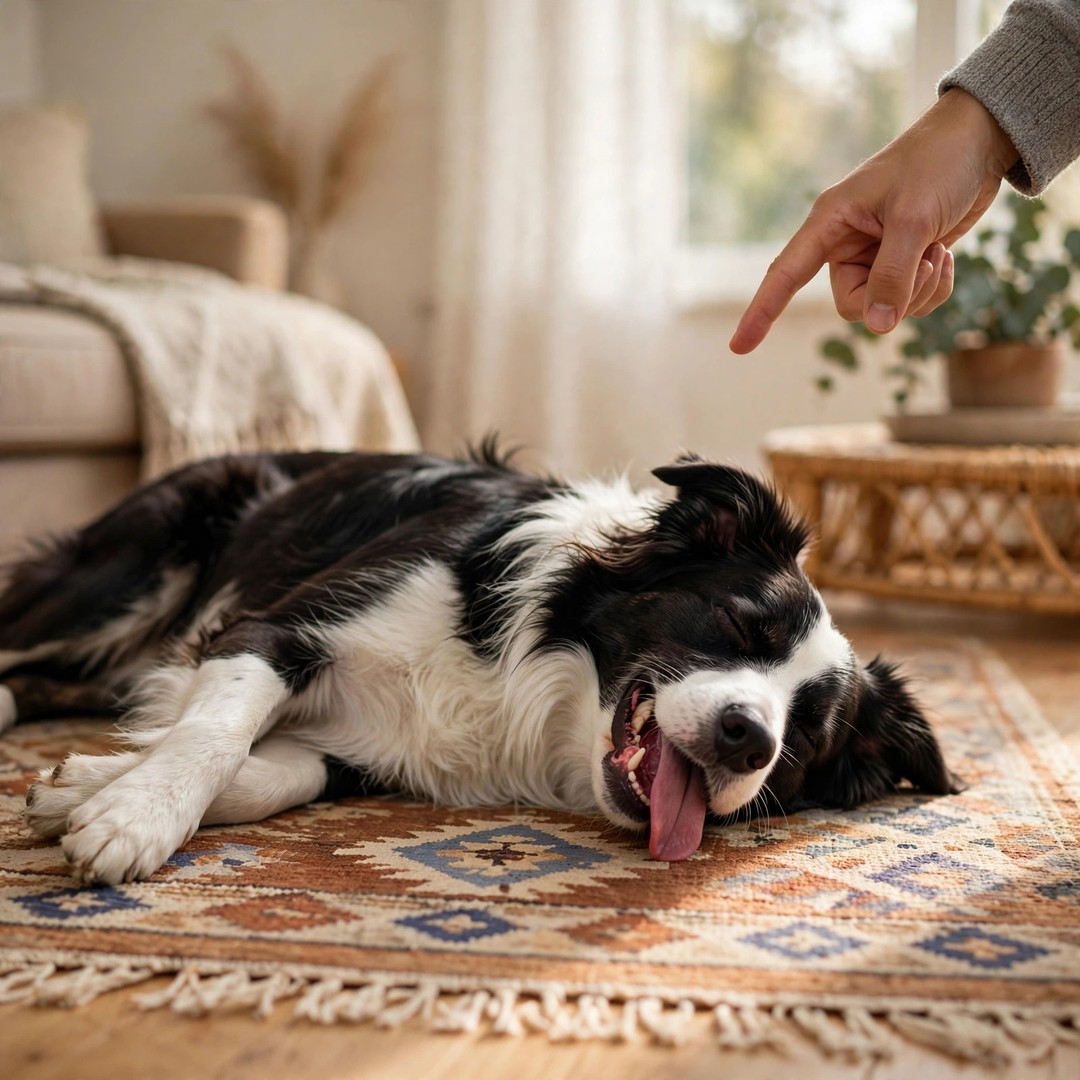
You point your finger, say “bang”, and your dog flops dramatically onto his side, tongue out, completely still — and everyone in the room laughs. Play dead is one of the most charming tricks a dog can learn, and it looks far harder than it is. If your dog already knows how to lie down, you are most of the way there.
It is also a genuinely useful trick. It teaches your dog to settle on cue, to stay still on his side, and to listen for your words even when he is excited. Best of all, it is pure fun — for both of you.
Why this matters
Tricks are not just for showing off. They build the bond between you and your dog, they give him mental exercise, and they teach him that listening to you pays off. A dog that enjoys learning is a dog that is easier to train in everything else, from coming when called to walking calmly on the lead.
Play dead is a great trick to teach because it is built on something your dog already does: lying down and rolling onto his side. You are not asking for anything strange or uncomfortable. You are simply putting a cue on a movement he already knows, and making it a game. Almost any dog can learn it, at almost any age.
Before you start
You will need:
- Small, tasty treats your dog loves, cut into pea-sized pieces. Use something really good for this — a fun trick needs to pay well.
- A comfortable surface — a rug, a dog bed, or a patch of grass. Your dog will be lying on his side, so a hard floor is not ideal.
- Five minutes at a time — short sessions, a few times a day, beat one long frustrated session.
- A cheerful voice. Dogs learn fastest when training feels like a game, not a test.
Start when your dog is relaxed but not sleepy, and work somewhere without other dogs or distractions. If your dog already knows “lie down” reliably, you can move through the first steps quickly. If not, teach that first — play dead is really just a fancy version of lying down.
Step 1: Lie down first
Ask your dog to lie down, exactly as you normally would. Reward him the moment his belly touches the floor. Do this a few times until he is happily lying down on cue. This is the foundation of the whole trick, so do not rush it.
If your dog does not lie down on cue yet, lure him: hold a treat near his nose, move it slowly down to the floor between his front paws, and reward the moment he lies down. A few sessions of this and most dogs have it.
Step 2: Roll onto the side
This is the key step. While your dog is lying down, hold a treat near his nose and move it slowly to the side, toward his shoulder, so his head follows it. As his head turns, his body will naturally roll onto one side. The moment he is lying on his side, say “yes!” and give him the treat.
Do not push him over or roll him yourself — let the treat do the work. Some dogs roll easily on the first try. Others need a few sessions of small steps: head turn, then a lean, then a full roll. Reward every step in the right direction, even if it is just a head turn at first. That is how the trick is built.
Step 3: Add the cue
When your dog is happily rolling onto his side for a treat, add your words. As he starts to roll, say “bang!” or “play dead” in a bright, playful voice — one clear cue, said once. Then reward him the moment he is on his side.
Pick one cue and stick to it. If you say “bang” one day and “play dead” the next, your dog will not know which one you mean. Most owners use “bang” with a finger-gun gesture, which makes the whole thing funnier — and the gesture becomes a cue your dog can follow on its own.
Step 4: Build the stillness
A dog that rolls over and pops straight back up is not playing dead — he is just rolling. Now teach him to stay there. Once he is on his side, wait two seconds before giving the treat. Then three seconds, then five. Build up slowly, a few seconds at a time.
If he gets up too soon, just stay calm and start again. Do not scold him. Getting up is information, not disobedience — it tells you that you asked for a little too much, too soon. Go back to shorter stays and build up more slowly.
Step 5: Add the drama
Once your dog can lie on his side for ten seconds, add the finishing touches. A dramatic pause before the cue. A slow finger-gun. A big, theatrical reaction from you when he flops over — dogs love an audience, and a happy owner is the best reward there is.
Practise in different rooms, and then with a friend watching. Dogs do not generalise well — a trick learned in the kitchen does not automatically work in the garden. A few practice sessions in new places, and your dog will play dead anywhere.
Troubleshooting
My dog will not roll onto his side. Try a different direction — some dogs prefer rolling to the left, others to the right. Try luring more slowly, and reward even a small head turn or a lean. If your dog seems stiff or uncomfortable rolling, stop and ask your vet — some older or arthritic dogs find the movement difficult, and the trick is not worth discomfort.
My dog rolls over but pops straight back up. You are probably rewarding too late, or asking for too long too soon. Reward the very moment he is on his side, and build the stillness up in tiny steps — two seconds, then three, then five.
My dog only does it when he sees a treat. That is normal at first. Fade the lure gradually: hold the treat in your pocket, then reward him from your pocket after he rolls over. The trick stays, the visible treat fades.
My dog gets too excited and will not settle. Keep the sessions shorter and calmer. If he is bouncing around, wait for a quiet moment, or practise after a walk when he has burned off some energy. A calm dog learns faster than a wired one.
What not to do
Never push your dog over or hold him down on his side. Forcing it teaches him that the trick is something done to him, not something he chooses — and a dog that feels forced will not enjoy it. Never scold him for getting it wrong. And never practise on a hard or slippery floor, where rolling could hurt him. A rug, a bed, or grass is the right surface.
A trick worth teaching
Play dead takes patience, a handful of treats, and a dog who trusts you enough to flop over on cue. Teach it slowly, keep it fun, and you will have a trick that makes everyone smile — and a dog who has learned that listening to you is the best game there is.
Has your dog learned to play dead? How long did it take, and what finally made it click? Tell us in the comments — other dog owners will love the story.
This article is for general information only and is not veterinary advice. If you are worried about your dog’s behaviour or health, please consult a veterinarian or a certified professional trainer.