
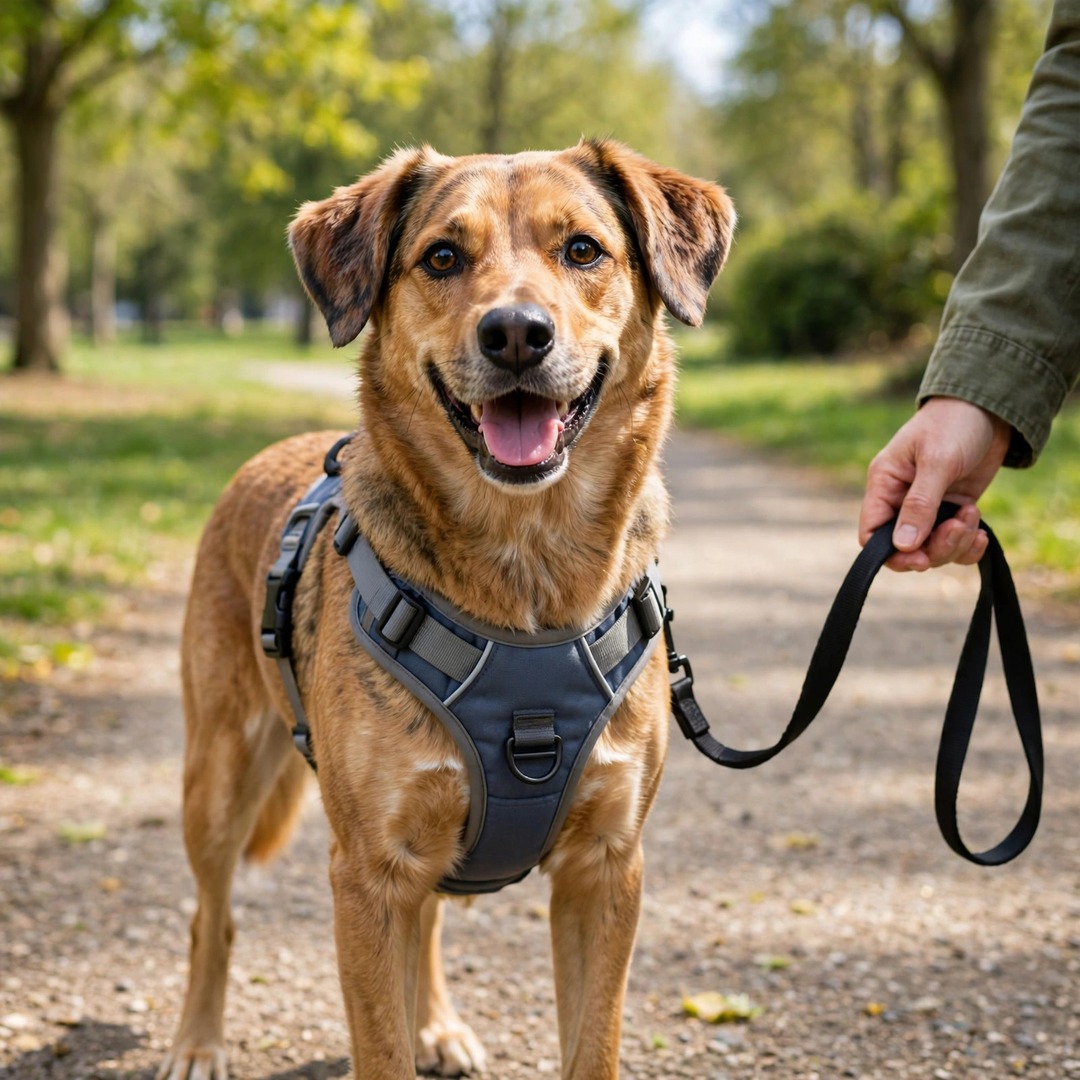
You step out the door, your dog spots a squirrel, and suddenly you are being towed down the street like a water-skier. Your arm aches, your shoulder aches, and your dog is not even trying to be naughty — he just wants to get there faster. If that sounds familiar, you have probably wondered whether a harness could help. The honest answer is yes, the right harness can make walks calmer — but only if you choose the right style and fit it properly.
A harness is not a magic fix for pulling. It is a tool, and like any tool, it works well in the right hands and poorly in the wrong ones. Here is how to choose one that genuinely helps you and your dog.
Why This Matters
Pulling is not just annoying — it can hurt both of you. A dog that pulls hard on a collar puts pressure on his neck and throat, and over time that can cause coughing, a sore throat, or worse. For you, a strong puller can strain your shoulder, your wrist, and your back, and a sudden lunge can pull you off balance.
A well-chosen harness spreads pressure across the chest and shoulders instead of the neck, which is safer for your dog and more comfortable for you. It also gives you better control in busy places — near roads, around other dogs, or at the vet — without hurting your dog to get it.
The Main Types of Harness
Front-clip harnesses
A front-clip harness has the leash ring on the dog’s chest, at the front. When your dog pulls, the front attachment gently turns his body back towards you, which makes pulling less rewarding. This is the style most trainers recommend first for a dog that pulls, because it works with your dog’s movement rather than against it.
Back-clip harnesses
A back-clip harness has the leash ring between the shoulder blades. It is comfortable and easy to put on, and it is fine for a dog that already walks politely. But for a strong puller, it can make things worse — the clip sits right where a sled dog’s harness pulls from, so it can actually encourage your dog to lean into the pull.
Dual-clip harnesses
A dual-clip harness has rings at both the front and the back. You can clip the leash to the front for training walks, and to the back for relaxed walks once your dog is walking well. This is a good choice if you want one harness that grows with your training.
Head halters
A head halter fits around your dog’s muzzle and behind his ears, a bit like a horse’s bridle. It gives you a lot of steering control, because where the head goes, the body follows. It is not a harness, and it is not a muzzle — your dog can still open his mouth, pant, and take treats. It suits very strong dogs, but it needs a slow, patient introduction, because many dogs hate the feeling at first.
How to Get the Fit Right
A harness only works if it fits. Too loose, and your dog can slip out of it — usually at the worst possible moment. Too tight, and it rubs, chafes, and makes your dog hate walks.
Here is the fitting check that matters most: once the harness is on, you should be able to slide two flat fingers under every strap, but not much more. If you can fit your whole hand underneath, it is too loose. If you cannot get two fingers in, it is too tight.
Check these spots:
- Around the chest — the strap should sit behind the front legs, not right in the armpits, where it will rub raw.
- Across the shoulders — the harness should not press on the shoulder joints or restrict how your dog moves his front legs.
- At the neck — the neck strap should sit low on the chest, not high against the throat.
Measure your dog before you buy: around the widest part of the chest, just behind the front legs, and around the base of the neck. Every brand sizes differently, so always check that brand’s size chart rather than guessing from the label.
What to Look For When You Buy
- Padded straps — padding on the chest and belly straps stops rubbing on long walks and makes the harness comfortable enough to wear happily.
- Adjustable straps — a harness with adjustments at the neck and chest lets you fine-tune the fit as your dog grows or gains weight.
- A sturdy front ring — the front clip should be metal, well sewn in, and positioned on the centre of the chest.
- Easy to put on — step-in styles and over-the-head styles both work, but choose one you can get on your dog without a wrestling match. If putting it on is a battle, your dog will start dreading walks.
- Reflective strips — useful if you walk in the early morning or after dark, so drivers and cyclists can see your dog.
What to Avoid
- Harnesses that squeeze the shoulders — some cheap designs sit across the shoulder joints and restrict movement, which can cause stiffness or injury over time.
- Very thin straps — a narrow strap concentrates pressure on a small area, which is uncomfortable and can cut into the skin.
- A harness as a substitute for training — a front-clip harness helps, but it does not teach your dog to walk nicely. Pair it with training, and you will get a dog that walks well even on a plain collar.
- Leaving the harness on all day — take it off at home. A harness left on can rub, mat the fur underneath, and trap moisture against the skin.
Training Alongside the Harness
The harness is half the answer; the other half is what you do on the walk. When your dog pulls, stop walking. Stand still, wait for the leash to slacken, and then walk on. Your dog learns that pulling stops the fun, and a loose leash keeps it going.
Reward the moments your dog walks beside you, even for a few steps, with a treat or a happy word. Short, calm sessions beat one long frustrated walk. And practise in quiet streets first — asking a dog not to pull past a squirrel on day one is asking too much.
If your dog is very strong, or you feel unsafe on walks, ask a certified professional trainer for help. There is no shame in it — a strong puller can injure you, and a trainer can show you a technique that fits your dog in a single session.
The Bottom Line
The best dog harness for pulling is a well-fitted front-clip or dual-clip harness with padded, adjustable straps, sized to your dog’s chest and fitted with the two-finger check. It spreads pressure safely across the chest, gives you control without hurting your dog, and — paired with a little training — turns the daily tow into a walk you both enjoy.
What harness does your dog wear, and did it actually help with the pulling? Tell us in the comments — other owners will love the honest answers.
This article is for general information only and is not veterinary advice. If you are worried about your dog’s health, please consult a veterinarian.