
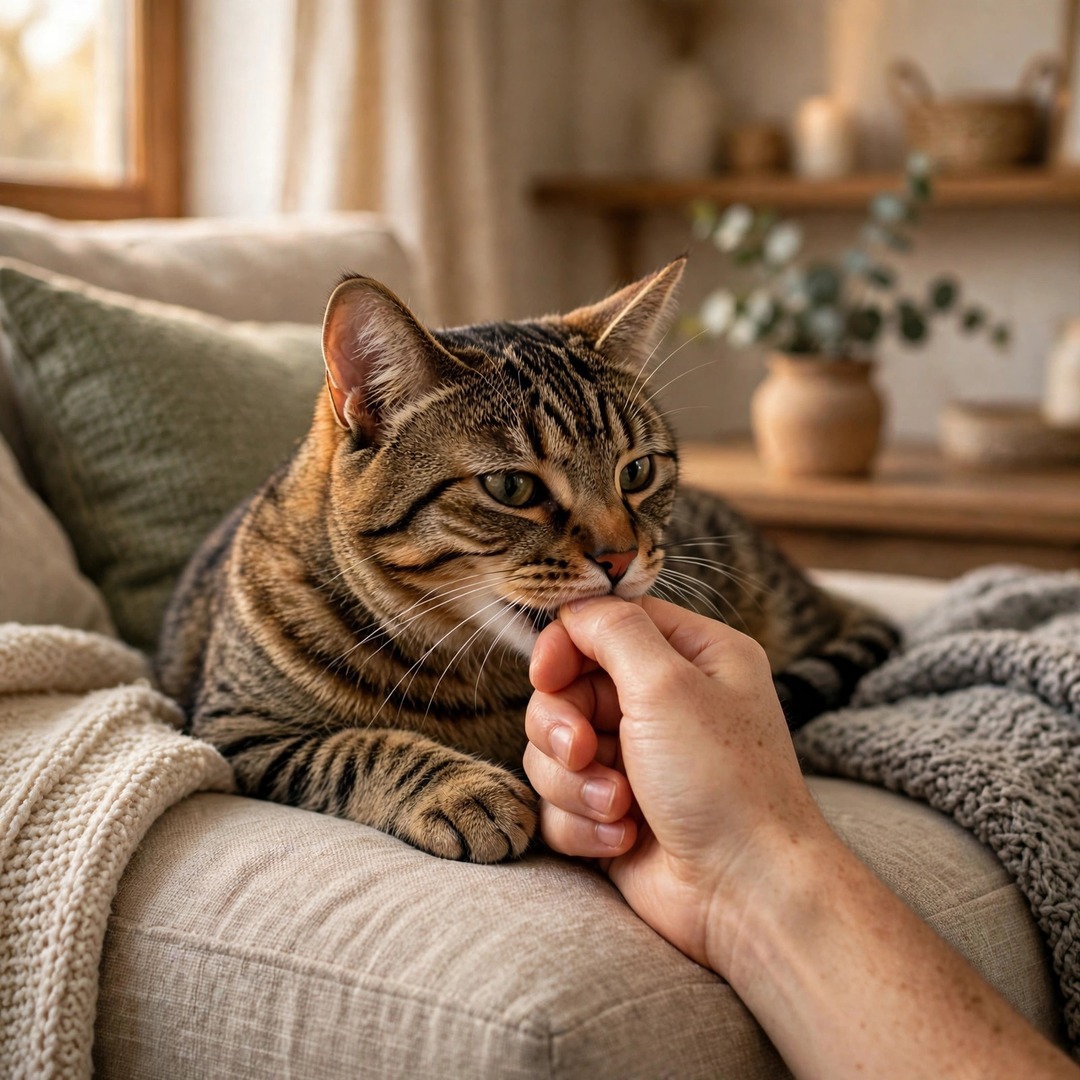
You are stroking your cat, she is purring, her eyes are half closed — and then, out of nowhere, she turns and bites your hand. Not hard enough to break the skin, but hard enough to make you jump. Or perhaps your cat ambushes your ankles every time you walk past, or grabs your hand during play and will not let go. It feels personal. It is not.
Cats bite for reasons, and once you know what those reasons are, the biting usually gets a lot easier to handle. Here are the honest ones.
Why This Matters
A bite is how your cat talks. She cannot tell you “that is enough now” or “I am in pain” or “I am bored” in words, so she uses the tools she has — her teeth and her claws. Most cat bites are not aggression. They are communication, and they are usually easy to fix once you understand what she is saying.
It also matters because cat bites can hurt more than they look. A cat’s teeth are sharp and thin, and a deep bite can push bacteria under the skin. A bite that breaks the skin should be washed well, and you should speak to a doctor if it becomes red, swollen, or painful.
Petting-Induced Biting
This is the most common reason, and the one that confuses owners most. You are stroking your cat, she seems happy — and then she bites. What happened?
Cats have a limit for petting, and it is often shorter than you think. The belly is the classic trap: a cat that rolls over and shows her tummy is not always inviting a belly rub. Often she is just stretching, or showing trust — and a hand on her belly feels like a threat, not an invitation.
Watch for the warning signs: her tail starts flicking, her ears flatten slightly, her skin ripples along her back, or she turns her head to look at your hand. Any of those means “enough”. Stop stroking, let her walk away, and you will get far fewer bites.
Play Biting
Kittens learn to bite during play, and it is normal — with their littermates, a bite that is too hard gets a yelp and the game stops. A kitten raised without other cats, or played with using hands, can grow up thinking hands are toys.
If your cat bites during play, the rule is simple: hands are not toys. Never wiggle your fingers for her to chase, and never wrestle with your hands. Use a wand toy or a ball instead, so her teeth and claws land on the toy, not on you. When she does bite your hand, freeze — do not pull away, because pulling away triggers her chase instinct. Go still, wait for her to let go, and then end the game calmly for a few minutes.
Fear or Pain
A cat that is frightened bites to protect herself. A new person, a loud noise, a dog in the house, or being cornered can all make a cat feel trapped, and a trapped cat bites. Give her space, let her hide, and do not reach for her when she is scared.
Pain is the reason owners miss most. A cat that has always been friendly and suddenly starts biting — especially when you touch a certain spot — may be hurting. Arthritis, a sore tooth, an injury, or an infection can all make a cat lash out when touched. If the biting is new, or it happens when you touch one particular area, book a vet visit. It is always better to check.
Redirected Biting
Sometimes a cat is wound up by something she cannot reach — a bird outside the window, another cat in the garden — and she turns and bites the nearest thing, which happens to be you. This is called redirected aggression, and it is not personal. She is full of energy with nowhere to put it.
If your cat is staring fixedly out of the window, tail lashing, and you walk past at the wrong moment, you may get bitten. Give her a few minutes to calm down, and try to block the view of whatever is exciting her — a curtain, or moving her favourite perch away from that window.
What To Do When Your Cat Bites
- Stay calm and go still. Do not shout, do not pull away sharply, and never hit your cat. That only makes her more frightened, and more likely to bite harder next time.
- End the interaction. Put her down gently, walk away, and ignore her for a few minutes. She learns that biting stops the fun.
- Wash any bite that breaks the skin. Clean it with soap and water, and watch it. If it becomes red, hot, swollen, or painful, speak to a doctor — cat bites can become infected quickly.
- Never punish a bite. Punishment teaches a cat to fear you, not to stop biting. It also teaches her to bite without warning next time, which is worse.
What Not To Do
Do not play with your hands, do not punish your cat, and do not force her to be held or stroked when she is showing you she has had enough. Do not pick her up when she is clearly agitated, and do not corner her. And never, ever use your hands to tease a kitten — it is cute when she is tiny, and it is a real problem when she is a five-kilo adult with adult teeth.
The Bottom Line
Why does my cat bite me? Usually because she has had enough petting, because she thinks your hands are toys, because she is frightened, in pain, or wound up by something outside. Watch her body language, keep hands out of play, give her space when she asks for it, and check with your vet if the biting is new or sudden. Most biting fades fast once you understand what she is trying to say.
Does your cat bite when you stroke her — and have you worked out her limit? Tell us in the comments; other cat owners will love the honest answers.
This article is for general information only and is not veterinary advice. If you are worried about your cat’s behaviour or health, please consult a veterinarian.